
What Is a Flange Ball Valve?
What Is a Flange Ball Valve?
A flange ball valve is a quarter-turn shut-off device that combines a floating or trunnion-mounted ball with integral pipe-flange connections (ANSI B16.5, DIN EN 1092-1, JIS B2220, etc.) so that it can be bolted directly between line flanges without extra adapters.
Built on the foundation of a standard two-piece (2PC) or three-piece (3PC) ball valve body, it adds raised-face (RF) or ring-type-joint (RTJ) flanges cast or forged as one piece, giving a compact, high-strength joint that resists pipeline bending moments.
When the stem is rotated 90°, the bored ball aligns with the pipeline (open) or blocks it (closed) while the seat rings maintain bubble-tight shut-off; the flanged ends allow complete valve removal for in-line maintenance without disturbing adjacent piping.
Compared with a threaded-end ball valve, a flange ball valve not only offers higher pressure/temperature ratings (PN16–PN100, Class 150–2500) but also provides standardized mounting pads (ISO 5211) for direct actuator attachment, greatly simplifying automation projects .
Working Principle of a Flange Ball Valve
The core function is to convert a quarter-turn input into full-flow or positive shut-off while withstanding axial stresses transmitted by the pipeline flanges.
Its operation can be understood in two stages: sealing mechanics and flange load management.
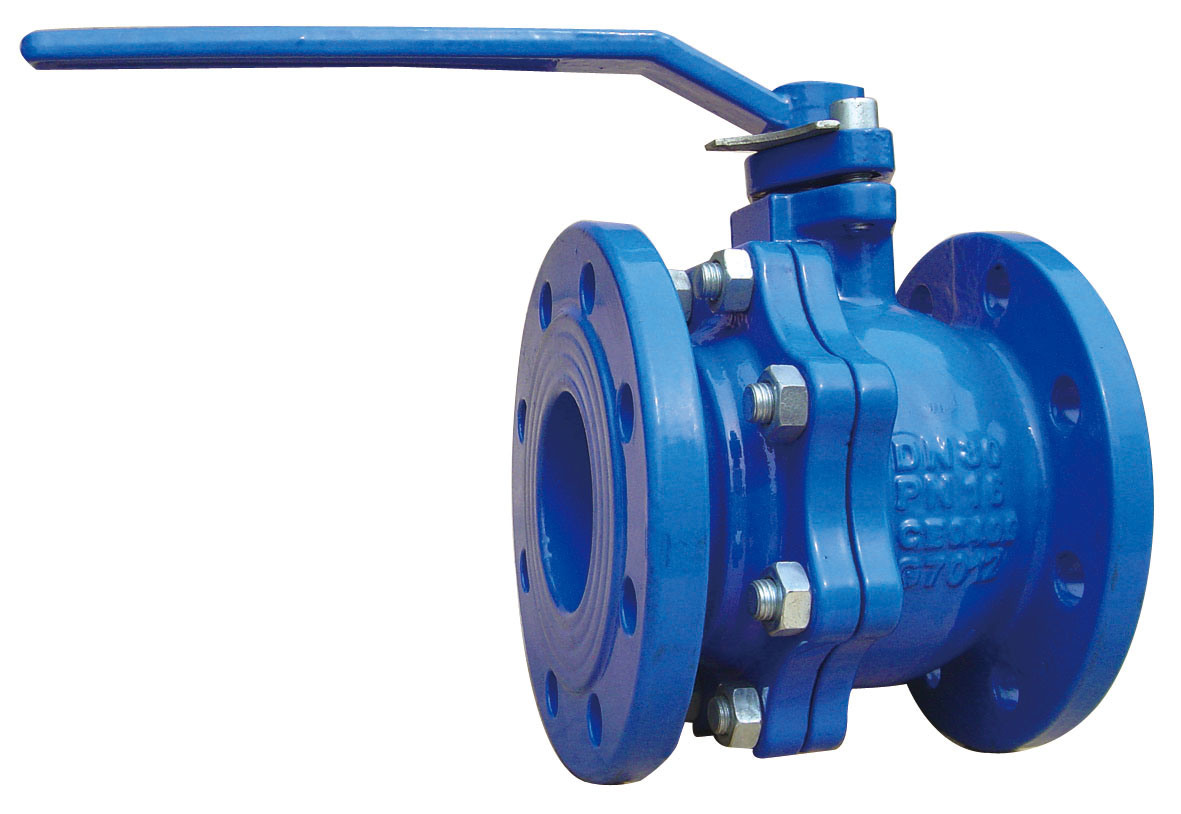
1. Sealing Mechanics
A floating ball is wedged between two seat rings by line pressure; when closed, upstream pressure pushes the ball downstream, compressing the seat and creating tight seal.
In trunnion designs used above 4 in / PN40, the ball is fixed and seats are spring-loaded, reducing operating torque and wear .
2. Flange Load Management
The body flanges are drilled to match pipe flanges; high-tensile studs preload the gasket, creating a seal that absorbs pipeline thrust and bending moments without stressing the ball/stem interface .
Example of Status Feedback
- Valve open → stem groove aligns with flow (green indicator): full Cv realised.
- Valve closed → stem perpendicular, seat compression 0.3 mm (red indicator): zero leakage per API 598.
- Partial turn → misalignment 5°: system displays “seat wear” if torque > 150 N·m.
Importance of Flange Ball Valves
Permitting Full-Bore, Low-Loss Flow
Especially in petrochemical or LNG lines, the full-port design gives same inside diameter as pipe, reducing pumping costs and pigging issues .
Enabling Rapid Automation
ISO 5211 mounting pads cast on top of the body let pneumatic or electric actuators bolt directly without brackets, cutting installation time 30 % and eliminating coupling misalignment .
Compliance with International Standards
Face-to-face dimensions follow DIN EN 558, ASME B16.10 or JIS B2002, guaranteeing drop-in replacement during plant upgrades or global projects .
Types of Flange Ball Valves
1. By Body Style
2-Piece Flange Ball Valve:
Body split in middle; cheaper, but seat replacement requires line drop .
3-Piece Flange Ball Valve:
Center section swings out after removing body bolts—seat change in minutes, popular for hygienic or high-purity lines.
Top-Entry Flange Ball Valve:
Bonnet on top; weld in-line, remove bonnet for internal access—used on buried gas lines.
2. By Bore Size
Full-Port:
ID equals pipe ID; lowest pressure loss, allows pipeline pigging.
Reduced-Port:
One size smaller; lighter, lower cost, acceptable for throttling duties.
3. By Seat & Seal
PTFE Seat:
−20 °C to 200 °C, excellent chemical inertia; standard for water, oil, gas.
Metal-Seat (STL overlay):
Up to 550 °C, resists flashing in steam or catalytic reformers .
Cryogenic Extension:
Stem extended past cold box; used at −196 °C LNG loading arms .
Applications of Flange Ball Valves
Oil & Gas Transmission
Trunnion-mounted, forged-steel Class 600 valves with double-block-and-bleed seats isolate pipeline sections for pig launcher access .
Chemical & Petrochemical
CF8M (316) stainless 2PC valves with RTFE seats handle corrosive organics; fire-safe design meets API 607.
Power Plant Steam & Condensate
Carbon-steel WCB bodies with graphite gaskets and PEEK seats operate at 250 °C, 40 bar, providing tight shut-off for turbine bypass .
Water Works & Building Services
EPDM-seated PN16 valves connect to ductile-iron flanges, offering bi-directional sealing and WRAS approval for potable water .
Selection Recommendations
For high-cycle steam lines up to 250 °C, specify a 3-piece full-port flange ball valve in WCB with spiral-wound graphite gasket and PEEK seats—maintains shut-off after 50 000 cycles and meets API 607 fire-safe.
For corrosive chemical batching, choose a 2PC CF8M body, PTFE seats, ISO 5211 F07 pad and live-loaded packing—direct actuator mounting plus low fugitive emissions.
Flange ball valves are now an essential component of modern piping systems, perfectly combining end-connection strength, quarter-turn operation and automation readiness in one compact body.
Their wide use in oil terminals, chemical plants, power stations and building services reflects their importance in keeping processes safe, efficient and easy to maintain.
At Union Valve, we stock ½–12 inch flange ball valves in WCB, CF8, CF8M and duplex grades, all drilled to ANSI, DIN or JIS standards and pre-mounted with ISO 5211 pads for instant actuator fitting.
With API 598 testing, 18-month warranty and global logistics, every flange ball valve we ship is ready to bolt in and perform—today and for decades to come.
To learn more, visit the Union Valve official website—and feel free to contact us for dimensional drawings, material certificates or next-day quotations.



 8615510865705
 8615510865705